
PERANG TOPAT || the story behind
//Perang Topat: An Epic Saga of Peace Penned in the Heart of Lombok
Narasimedia.net || On the island of Lombok, a variety of traditional war customs are still upheld and actively practiced to this day. However, unlike typical warfare, these traditions hold deeper meanings and unique purposes. These are not battles of blood, but of brotherhood. They are sacred tapestries of tradition, woven with tolerance, unity, and the spirit of collaboration, particularly between Hindus and Muslims.
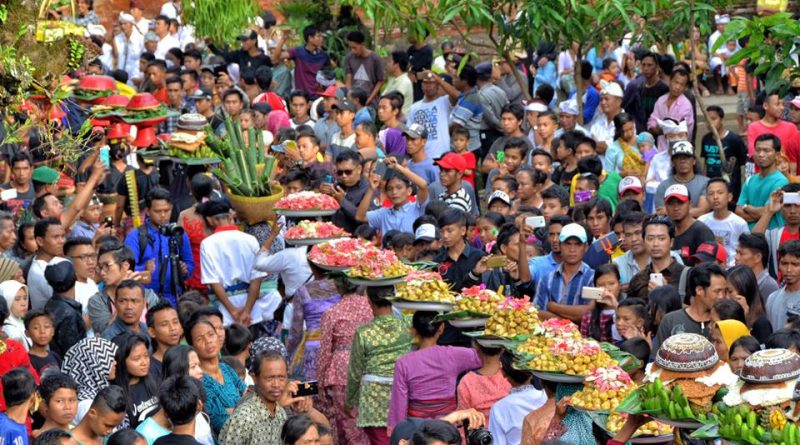
One particularly renowned tradition is the Perang Topat in the village of Lingsar, celebrated annually by both Muslims and Hindus at the Lingsar temple. Intriguingly, despite involving both Hindu and Muslim participants, this ritual has evolved into a symbol of the power of religious tolerance in the Lingsar District.
The Perang Topat ritual takes place annually in the month of Purnama Sasih Ke Pituq (the 7th full moon) according to the Sasak calendar, which roughly corresponds to around November or December, marked by an event called Roroq Kembang Waru (the falling of the waru flower).
Gegen Redrebels wrote on his Facebook page:
According to H. L. Azhar in his book “Arya Banjar Getas,” the tradition of the Topat War in Lingsar originated from the king of Singhasari Lombok to commemorate Karangasem’s victory over the Pejanggik and Selaparang kingdoms of Lombok. The event was designed as a festive competition and combined with a Pujawali ceremony, which is a prayer for rain.
The conflict between Pejanggik and Karangasem spanned from 1721 to 1722, while the war between Selaparang and Karangasem occurred from 1723 to 1725.
Based on the Arya Banjar Getas book by H. Lalu Azhar, following the Pejanggik war in 1722, the Karangasem forces departed from Memelak towards Lingsar, where I Gusti Ngurah Kaba and I Gusti Bagus Alit, leaders of the Karangasem forces, established a camp (pesanggrahan). At that time in Lingsar, a community practicing Islam Waktu Telu already existed. Eventually, the former camp of I Gusti Ngurah Kaba and I Gusti Bagus Alit was transformed into a temple complex, situated alongside a kemaliq, a place of worship for the Waktu Telu community.
In 1775, in the western part of Lombok, several Hindu-Balinese-influenced kingdoms emerged, including Singasari Sasak, Mataram, Pagutan, and Pagesangan. Singasari and Mataram were the most influential among them.
The Singasari king wanted to organize a festive competition to end the long-standing conflict between the Sasak Muslim community and the Balinese Hindu community.
In fact, the tradition of sporting wars was known to several kingdoms of Sasak Lombok even long before the kingdoms of Singasari and Mataram existed, and it had already been practiced since the early days by the Selaparang kingdom.
Back in the 1500s, during the reign of Prabu Lombok in Selaparang, a prolonged war occurred between Demung Brang Bantun and the king of Selaparang. This conflict stemmed from Demung Brang Bantun seeking retribution for the deceitful assassination of his brother, Demung Sandubaya, orchestrated at the behest of Prabu Lombok.
Subsequently, Prabu Lombok was succeeded by Prabu Rangkasari, during whose reign the sporting war was first organized. It is said that Prabu Rangkasari successfully reconciled the followers of Demung Brang Bantun with Selaparang. To commemorate this reconciliation, the sporting war was established with the aim of erasing the grudges between the two factions that had been involved in the war.
Under Prabu Rangkasari’s orders, the people of Selaparang were tasked with preparing various seafood-based dishes such as grilled fish, crabs, squid, and others, while the people of Brang Bantun were instructed to prepare topat, timbung, renggi, pangan, tekel, cerorot, and the like.
Thus, the sporting war eventually took place. Following the war, both factions held a communal feast, and the animosity between them gradually faded away.
Through the Perang Topat, the people of Lombok have taught us that any form of enmity can ultimately be resolved through joy and celebration.
Wiriten by Adit R. Alfath